
 Deutsch
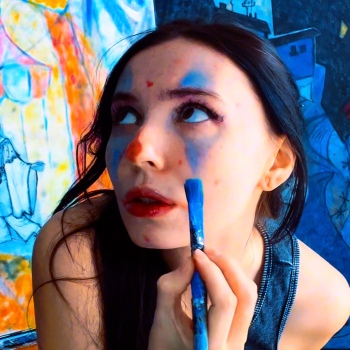
The artistic practice of Anastasia Kuklina represents a consistent exploration of the dialectic between the individual and the social. Several periods stand out in the evolution of her method, each marking a specific stage of this analysis while simultaneously highlighting the search for an authentic visual language.
“The Archetype of the Hero” is the initial period, in which the theme of the figure embarking on a journey of self-determination is formed. Here, the first contours of the style are outlined, and the moment of the subject’s reflection on their own boundaries is captured.
“The Society of the Spectacle” introduces the theme of the conflict between individuality and the social environment. The visual language gains rigidity through a contrasting tricolor and fragmentation, capturing the tension between genuine intentions and external scripts.
“The Dreams of Society” shifts the theme into the realm of the unconscious. The work, starting from a blot and spontaneous movement of form, brings to the forefront processes that are not controlled by social rationality.
“The Society of Comedians” focuses on the theatricality of everyday existence—the mechanisms of role adaptation and the construction of identity to fit into a group.
“The Survivor’s Fallacy” is directed at the post-play state: the silence that remains after the social spectacle ends, and the question of the content of inner experience beyond adaptation.
A special place is held by the cycles “Dreams” (a branch from the project of the same name, where narratives are born directly in the process, united by a stylistic approach) and “Identity” (a search for a different perspective through cultural memory and traditional images; papier-mâché kokoshniks as an attempt to speak about belonging to the “greater” through tactility).
The practice includes painting, graphics, sculpture, and media art. The material is subordinated to the task: from the tactility of the handmade object to digital transformation. Emotional tension serves as a means of engaging the viewer in a dialogue about issues that remain beyond everyday reflection.