
 Deutsch
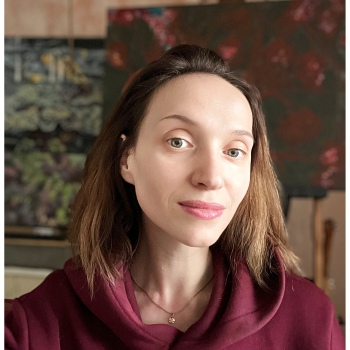
Darya Kharlauta (b. 1987, Russia) is a contemporary artist whose works lie at the intersection of painting and object. Her practice revolves around a unique method she developed over fifteen years: “mental archaeology” — a speculative exploration of cultural layers where ancient mythological systems, traditions, and the sensory language of the digital age converge at a single point.
The artist’s formation is rooted in a rare synthesis of academic rigor and field research. After earning a bachelor’s degree in easel painting from Herzen State Pedagogical University, St. Petersburg (2009), she spent six years participating in archaeological and ethnographic expeditions across the Arctic and Scandinavia (2009–2015). This immersion in extreme landscapes and ancient cultures fundamentally shaped her understanding of materiality, time, and the resilience of myth — elements that continue to nourish her work to this day.
Throughout her career, Kharlauta has created over 400 works and held 13 solo exhibitions. Her works have been featured in more than 70 group exhibitions worldwide, including venues in Russia, the Czech Republic, the United Kingdom, Italy, and Israel. Her works are held in private collections in these countries, as well as in the permanent collection of the V.A. Noskin Open Museum in St. Petersburg (“Flame, Ash, and Snow,” 2021).
A central concept in the artist’s vocabulary is the notion of the “hybrid artifact” — works that exist on the border between archaic ritual and post-Anthropocene aesthetics. These pieces are characterized by multilayered textures, the inclusion of natural materials (mineral pigments, wood, bronze), and a dialogue between handmade and technological processes (airbrushing, engraving, polymers). Her method, which she calls “sensory alchemy,” translates complex multisensory experience into tangible form, inviting the viewer into a dialogue that goes beyond purely visual perception.
The current series, “Sleep on the Eve of Spring,” deepens this exploration by creating painted canvases and objects that function as material witnesses to the collision of deep time and technological present. Her works engage with contemporary discourses — reflections on the post-Anthropocene, nonhuman agency, and the search for new spiritualities — while maintaining a strict commitment to material craftsmanship and formal integrity.